Nature, Memory and Recovery: Lessons from Carriacou
As part of the COEVOLEVERS project, we had the wonderful opportunity to visit our Oversea Cousin Kido foundation in Carriacou, Grenada. The purpose of the visit was to learn collaboratively about the nature-based solutions (NBS) in Carriacou, ongoing nature conservation initiatives, and the socio-ecological conditions of the island following the devastation caused by Hurricane Beryl. From 5 to 14 April, six COEVOLEVRS colleagues from Finland and Slovakia visited Carriacou to deepen their understanding of how NBS are lived, practiced, and reimagined in a small island community recovering after a disaster. The visit offered valuable insights into the impacts of the hurricane on local ecosystems, communities, and the wider socio-ecological system. The visit also enabled us to combine hands-on ecosystem restoration, methodological exchange, and community engagement in a post-Hurricane Beryl context. We are deeply grateful for the hospitality, generosity, and the support of our dear overseas cousin, the KIDO foundation. Their warmth and guidance made the visit truly inspiring, memorable, and the experience will be long cherished.


Before arriving, some expectations were to learn more about local ecosystem restoration activities and participatory approaches, but what made the visit particularly meaningful was the way ecological restoration, culture, memory, and livelihoods were deeply intertwined. What we also encountered was a much broader reflection on resilience: how communities rebuild not only damaged infrastructure and ecosystems, but also social relations, stories, and futures.
Forests, mangroves, beaches, and coastal wetlands are not only ecological systems but also places of memory, livelihood, learning, and identity. Visiting the island after Hurricane Beryl revealed both the immense vulnerability of small island environments and the remarkable resilience of local communities working to restore them. The experience showed how NBS are not simply technical interventions, but social and cultural processes rooted in local knowledge, collective care, and long-term relationships with place and other species.
Among the many memorable moments was participating in “Knowing the Nature Together” activities with local children. Their knowledge of island ecosystems, species, and environmental change was striking. They explained local plants, animals, and coastal dynamics with confidence and care, while also sharing stories about how Hurricane Beryl had affected their lives and homes. Some children described helping to clear debris or assist at the airport after the storm. These conversations revealed not only the scale of destruction, but also the strong sense of collective responsibility and resilience within the island community.

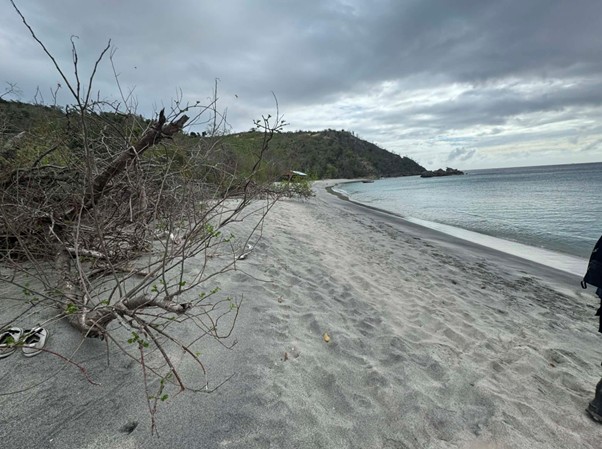
Seeing the impacts of Hurricane Beryl firsthand was another transformative experience. Traveling across the island revealed the broader ecological and social impacts of Hurricane Beryl. Coastal settlements had suffered severe structural damage, with many roofs partially or completely destroyed. On Carriacou, roofs are essential not only for shelter but also for rainwater harvesting, since groundwater resources are limited. Losing a roof, therefore, means losing access to fresh water as well as losing protection from the elements. The destruction extended far beyond damaged buildings. Mangrove ecosystems had been severely affected, trees uprooted, and coastal and slope areas eroded. Strong erosion also effected the forest and hills in the High North. The emotional impacts were equally significant. Many residents lost homes filled with memories, personal belongings, and emotional attachments accumulated over decades. Some older residents had to move in with relatives, disrupting long-standing relationships with place and independence.
Traditional ways of life and cultural memories were also disrupted. Older generations’ practices connected to small-scale farming, animals, and communal land use are increasingly under pressure, both from climate impacts and wider socio-economic change.
In this connection, one important theme concerned the relationship between conservation and livelihoods. During discussions with local stakeholders, questions repeatedly emerged about how eco-tourism or repurposing of discarded material and environmental protection can generate meaningful local employment. One example involved tensions between protecting sea turtle nesting areas and maintaining local businesses and jobs near beaches. These are not abstract policy dilemmas; they are everyday negotiations within communities where economic opportunities remain limited.
The hurricane exposed weaknesses in local construction methods, prompting discussions about more climate-resilient architecture.


Reinforced concrete, aerodynamic roof structures, and lightweight materials were all discussed as potential approaches for increasing resilience to future storms.


Another important aspect of the trip involved exploring the island’s historical and cultural landscapes. Visiting Windward, often called the “Scottish village,” revealed how settlement histories continue to shape local identity. Place names across the island often reflect former landowners or defining landscape characteristics, connecting geography with memory and history.
The visit to the historic slave graveyard was particularly powerful. Before Hurricane Beryl, the site had been enclosed by dense vegetation that created a sense of continuity and protection. The hurricane left the area exposed and physically altered, yet the graveyard remained an important cultural landscape connected to family histories and collective memory. Oral histories shared by local residents reinforced how landscapes can hold emotional and intergenerational significance far beyond their physical form.
At the same time, the visit highlighted how communities actively work to preserve and transmit memory. Storytelling played a central role throughout the mobility. Dario from KIDO shared histories connected to “blood trees,” indigo production, ponds, wells, and cultural landscapes – both with us and young local community members.


The visit also offered important insights into the practical complexities of ecosystem restoration. One of the most striking visits was to Anse La Roche Nature Reserve. The effects of Hurricane Beryl were immediately visible throughout the forest. Mature trees had been uprooted or snapped apart, especially along exposed ridges and slopes where wind intensity had been strongest. The damage illustrated how vulnerable structurally exposed ecosystems can be during extreme weather events. At the same time, it highlighted the importance of forest restoration as a form of climate adaptation and mitigation.
Protected restoration zones have been fenced off to reduce grazing pressure from free-ranging livestock. Cattle, especially cows, regularly move through open grasslands and can destroy young saplings before they establish themselves. Inside these protected areas, replanting efforts focused on native and economically important species such as mahogany, gommier, and tamarind. These species are ecologically valuable because they contribute to biodiversity, forest structure, and long-term ecosystem recovery.
The restoration of a historic pond within the forest demonstrated how traditional ecological knowledge can support conservation work. Older community members helped identify the pond’s original location and historical function as a natural water catchment area. Through rehabilitation efforts, the pond once again retains and stores freshwater, which is particularly valuable on an island with limited groundwater resources. Women from the community actively use pond water to irrigate nearby reforestation sites, showing how ecological restoration is directly linked to everyday community practices.

The surrounding vegetation was also restored to stabilize soils and reduce erosion. Despite challenges such as damaged fencing caused by livestock, the pond now supports a surprisingly rich level of biodiversity, functioning as a small but important ecological refuge within the forest landscape.

The forest also provided opportunities to learn about species interactions and ecological adaptation. One memorable example was the Red-footed tortoise, a species that moves downslope during dry periods in search of water. These movements increase exposure to predators and human disturbances, including road accidents, highlighting the importance of maintaining connected habitats and undisturbed ecological corridors. The post-hurricane landscape also revealed new ecological possibilities: in damaged forest areas, papaya trees began to establish and bear fruit, despite earlier attempts by islanders to grow them having failed when the seedlings did not survive.


We participated in mangrove replanting activities and discussed the challenges involved in restoring coastal ecosystems after extreme weather events. Mangroves are essential for fish spawning, coastal protection, and biodiversity, yet restoration is expensive, labour-intensive, and dependent on local ecological knowledge. The planting process itself required careful technique. Holes were prepared for each propagule, soil was gently compacted around the roots, and bamboo stakes were inserted beside the seedlings to protect them from crabs and other disturbances. Despite these efforts, survival rates from previous planting projects had sometimes been low due to environmental stress, poor propagule quality, or predation. This showed that restoration work is often experimental and adaptive rather than straightforward. The mangroves also illustrated fascinating biological adaptations.

Expanding such activities requires funding, training, and long-term institutional support. Similar tensions emerged around tree planting and water management, where traditional grazing systems involving free-roaming cows and goats can conflict with reforestation efforts.


Participatory tools and methods were another central part of the exchange, building on the long-term experience of the SlovakGlobe - IFE SAS team in the development and application of participatory, behavioural and governance-oriented approaches. The ECOPOLY game, led by the SlovakGlobe - IFE SAS team, co-designed with KIDO Foundation, helped explore how people make decisions about natural resources, ecosystem services, cooperation, and governance under changing environmental conditions. In Carriacou, we experienced something remarkable: from the very beginning, local players used natural resources carefully and in balance, managing to sustain the ecosystem while also generating income. This perhaps reflected the realities of living in a small island environment, where resources are finite and environmental change is directly experienced. Another important achievement was that, for the first time, we were able to train a local facilitator in a very short time: after hearing the game explained for the first time, he successfully moderated the session himself. One of the small gifts prepared for the participants was a memory game depicting nature in Carriacou. Following the initiative of an active local representative, consideration was given to how the memory game could be further adapted to reflect local cultural aspects, not only the island’s natural environment.


The visit reinforced the importance of adapting participatory methods carefully to local conditions, including climate, cultural practices, and community rhythms. In hot climates and post-disaster contexts, flexibility and openness are essential. Often, the most valuable learning emerged not through structured activities alone, but through listening to stories and spending time together.
Some of the most inspiring moments came from observing children engage with nature through citizen science (I -spy: knowing the nature together, part of NatureNex App) and outdoor learning activities. At ponds, beaches, and forest sites, children identified birds, insects, trees, and crabs while sharing stories about their experiences in nature. Learning occurred informally through observation, exploration, storytelling, and discussion rather than through rigid instruction. The outdoor environment appeared to encourage openness and curiosity. Children who were initially shy gradually became more confident in sharing ideas and experiences.


Activities such as perspective-taking games (Umwelt Cards) encouraged children to imagine the world from the viewpoint of different species, helping develop empathy toward non-human life forms. Such approaches foster ecological awareness and systems thinking while also creating supportive spaces for communication and emotional expression. At the same time, discussions revealed social vulnerabilities affecting young people on the island. In this context, environmental education becomes more than conservation work. Nature serves as a “living classroom” where resilience, confidence, and practical life lessons are developed alongside ecological knowledge.
The mobility exceeded expectations, while also making clear how limited a one-week visit is in truly understanding the complexities of island ecosystems and multispecies relations. It also reinforced the importance of long-term collaboration rather than short-term project engagement. Future work should increasingly focus on enabling income generation linked to nature-based solutions, such as supporting educators, restoration workers, guides, and local infrastructure for environmental learning.
Perhaps most importantly, the visit highlighted the value of intergenerational and international exchange. Many young people expressed strong interest in connecting with youth from Europe to share experiences and knowledge about climate resilience and sustainability. If concepts such as “future generations” and “long-term sustainability” are to be taken seriously, projects should create opportunities for young people to visit each other’s communities and learn together directly.
Throughout the trip, the Kido Foundation emerged as a central actor connecting conservation, education, and community resilience. Their work extends beyond ecological restoration into youth engagement, storytelling, outdoor learning, and local empowerment. Forests, mangroves, ponds, and trails are treated not only as ecosystems but also as spaces for healing, reflection, and learning. One of the most important lessons from the experience was that resilience is not only about rebuilding physical infrastructure after disaster. It is also about rebuilding relationships between people, ecosystems, knowledge systems, and communities. Nature-based solutions in Carriacou are therefore social as much as ecological. They involve volunteers, local memories, children’s learning experiences, traditional ecological knowledge, and collective care for landscapes that sustain both biodiversity and identity.
Ultimately, the mobility in Carriacou showed that resilience is not only about rebuilding ecosystems or infrastructure. It is also about relationships, memory, storytelling, and collective care for both people and nature. These lessons will continue to shape our work within COEVOLVERS and future collaborations with KIDO Foundation.
Carriacou demonstrated that environmental restoration cannot be separated from questions of culture, education, and social well-being. Forests protect against storms, mangroves stabilize coastlines, and ponds retain freshwater. Yet these ecosystems also support stories, livelihoods, learning, and emotional attachments to place. The island’s recovery after Hurricane Beryl is still ongoing, and many challenges remain. However, what stood out most was the strength of local engagement and the belief that nature can play a central role in both ecological and social recovery. In Carriacou, resilience grows not only through rebuilding structures, but through restoring connections between people and the environments they call home.
Finally, we extend our sincere thanks to Carriacou for sharing inspiring insights into its NBS and the remarkable resilience demonstrated in the aftermath of Hurricane Beryl. We are especially grateful to the KIDO Foundation for their warm hospitality and for their dedicated efforts to protect the island’s natural environment while empowering local youth. Their work is both inspiring and impactful. For the COEVOLVERS team, this visit was a valuable opportunity to strengthen our connections, deepen our shared learning, and reaffirm our collective commitment to advancing nature-positive solutions that benefit both people and the planet.


Authors: Himansu Sekhar Mishra, Michael Kull, Stanislava Brnkalakova, Tatiana Kluvankova & Misa Tuomala